
Auto Drill: Galaxy
LAVA LABS OYUN YAZILIM VE PAZARLAMA ANONİM ŞİRKETİStrategy
4.3371.00 Reviews
- Version
- 25
- Installs
- 100.00K
- Age Rating
- Everyone
Screenshots


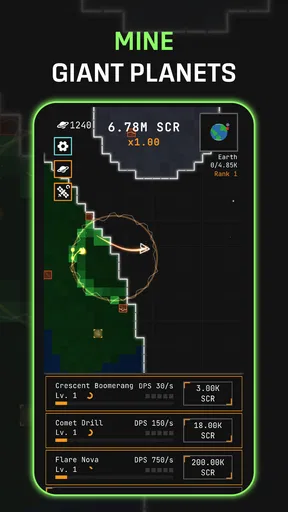
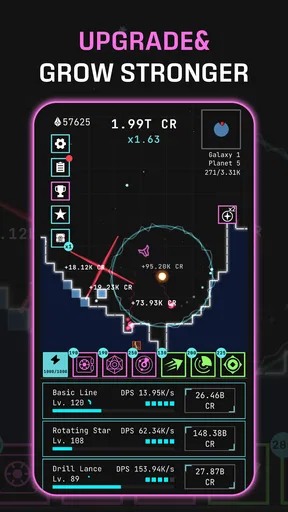
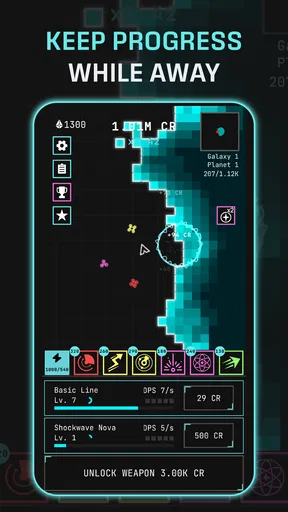
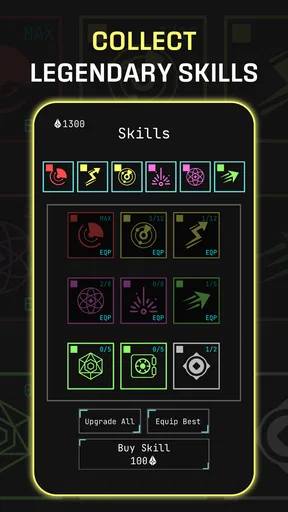
Our Review of Auto Drill: Galaxy
 Analysis by Appyee
I spent time with Auto Drill: Galaxy as a compact strategy game built around drilling through planets one block at a time. Its central idea is easy to understand: keep the drilling going, improve your tools, combine skills, and push farther when the next layer becomes more demanding. That simplicity makes it approachable, but it also means the quality of the experience depends heavily on how satisfying the upgrade loop feels over longer sessions.
My first impression was that this is designed for players who enjoy gradual progress rather than long, complicated missions. You can pick it up for a short break, make a few decisions, and put it down without needing to remember a large story or a complicated control scheme. The free entry point helps, and the Everyone age rating makes it suitable for a broad audience. Still, “easy to start” does not automatically mean “deep enough for everyone,” so the real question is whether the drilling and skill-fusing loop gives you enough meaningful choices to stay interested.
How the drilling loop turns simple actions into strategy
The game’s appeal comes from turning a basic action into a chain of decisions. Drilling is the visible activity, but the strategic layer comes from deciding how to improve your ability to continue. Weapons and skills are not just decorative additions; they represent the points where your progress can change direction. A player who treats every upgrade as equally useful may move forward, but someone who pays attention to how improvements work together should get more from each run.
I found that the best way to approach the game is to think in terms of momentum. When progress is moving smoothly, it is tempting to spend immediately on the first available improvement. That can be useful early on, but a more patient approach is often better: watch where the current setup begins to slow down, then choose the improvement that addresses that specific problem. If drilling feels weak, a general boost may help. If the issue is surviving or handling a tougher section, a different skill may be more valuable than raw speed.
This is one of the more important non-obvious lessons in strategy gameplay here: the strongest-looking option is not always the best next option. A skill that seems modest on its own can become more useful after being fused with another one. I would therefore avoid spending automatically whenever a new choice appears. Take a moment to consider whether the purchase or selection improves your current setup or merely looks impressive in isolation.
The block-by-block structure also gives the game a clear rhythm. You begin with a straightforward objective, build up your tools, and then face the consequences of earlier choices as the planet becomes harder to clear. That structure works well for short sessions because it gives each visit a recognizable purpose. You are not wandering through a large map wondering what to do next; you are trying to make the current drilling setup last longer and perform better.
For an everyday example, I can see this fitting neatly into a commute or a waiting room. You might start a session with the intention of playing for only a few minutes, make an upgrade decision, and stop after reaching a natural point. The game does not demand the same attention as a traditional turn-based strategy title, but it still gives you small choices to think about. That makes it more engaging than a completely passive idle experience, while remaining less demanding than a full tactical game.
Where the upgrade decisions matter most
The most useful habit is to separate immediate comfort from long-term value. An improvement that makes the next few blocks easier may not be the one that helps you reach a better overall position. When skills can be fused, I would keep a mental note of combinations instead of treating each skill as a finished product. Even without overcomplicating the system, planning one step ahead makes the game feel more strategic.
Another practical tip is to avoid changing too many things at once. If you replace several parts of your setup together, it becomes difficult to tell which choice actually helped. Making one meaningful adjustment, then observing the result, gives you a clearer sense of what your build is doing. This is especially useful for players who want to understand the game rather than simply tap through every available improvement.
That said, the strategy should not be overstated. This is still a streamlined mobile game, not a detailed simulation. The decisions are presented in a digestible format, and players looking for elaborate planning, a wide roster of units, or a long campaign with complex objectives may find the structure too narrow. Its strength is convenience and a clear loop, not the depth of a major console or PC strategy release.
Progress feels good, but pressure can change the mood
Progression is satisfying when each improvement is easy to understand and produces a noticeable difference. Auto Drill: Galaxy benefits from that kind of feedback because drilling is such a direct activity: you can quickly see whether your setup is helping you move more efficiently. The act of going farther gives the game a natural reason to continue, and the idea of unlocking stronger possibilities keeps the next session within reach.
The pressure arrives when progress slows. In games built around repeated upgrades, a small delay can feel motivating at first, because it encourages you to rethink your choices. If the slowdown becomes too frequent, however, the experience can shift from strategic problem-solving to waiting for another chance to improve. That is the point where I would pay attention to my own reaction. If I am making decisions, I feel involved; if I am only repeating the same action until the next boost appears, the game loses some of its appeal.
This distinction matters for spending as well. The game is free to download, while its in-app purchases range from $1.99 to $99.99 per item. Those are very different levels of commitment, so I would not treat the presence of purchases as a reason to spend automatically. A sensible approach is to play long enough to understand whether the basic loop is enjoyable without buying anything. If the drilling itself is not satisfying, a purchase is unlikely to fix that fundamental issue.
I also think players should decide in advance what kind of experience they want. If you enjoy earning progress slowly and experimenting with skills, the free version may be enough for a relaxed routine. If you dislike any form of progression pressure or prefer games where every tool is immediately available, the purchase structure may feel distracting even if you never buy anything. That is not necessarily a flaw unique to this title, but it is an important part of deciding whether it suits you.
Spending and fairness: what can be judged responsibly
The clearest confirmed point is that the game includes optional in-app purchases, with individual items priced between $1.99 and $99.99. I would be cautious about drawing stronger conclusions than that. The available facts do not establish whether purchases remove waiting, provide exclusive power, or are purely cosmetic, so I will not pretend to know how strongly spending affects competition or progression.
That uncertainty changes how I recommend approaching the game. If you are comfortable with free-to-play titles, set a personal limit before you begin and judge the game by its non-purchase loop first. Do not buy simply because a screen presents an attractive upgrade at a frustrating moment. Instead, ask whether you understand what the item changes and whether it improves the kind of play you actually enjoy.
For players who want a completely even playing field, this is a point to consider carefully. The game is categorized as a strategy title, and strategy fans often care about whether decisions matter more than spending. Because the known purchase range alone does not reveal the balance of the system, I would not label it definitively fair or unfair. My honest position is more practical: try the free experience, avoid assuming that a larger purchase guarantees better enjoyment, and stop if the pressure feels stronger than the strategy.
There is also a difference between convenience and value. A small purchase may feel reasonable if it supports a game you already enjoy, but the highest listed price represents a much more serious commitment. I would never recommend that level of spending to a new player before they have tested the core loop and decided that they genuinely want to keep playing. The game should earn your confidence through play, not through the promise of faster progress.
Who will enjoy it, and who should choose something else
I would recommend Auto Drill: Galaxy to players who like incremental improvement, short sessions, and light decision-making. It is a good match for someone who enjoys seeing a tool become more effective over time and who likes experimenting with combinations without learning a huge rulebook. It may also suit players moving from simple idle games toward more active strategy, because it adds choices to the progression without demanding the full commitment of a traditional tactical campaign.
It is less suitable for anyone looking for a strong narrative, competitive multiplayer, or highly detailed battlefield control. Players who want to position units, manage several resources at once, or plan around a large number of enemy types should look toward a more conventional strategy game. Likewise, people who become frustrated by repeated progression loops may find the block-by-block format too repetitive after the initial novelty fades.
Families may appreciate the Everyone age rating, but age suitability does not answer every practical question. A younger player may understand the drilling immediately, while the purchase system still deserves adult supervision. I would explain that the game is free to start but contains optional items with a wide price range. That conversation is more useful than assuming that a free download has no spending implications.
Device support, maturity, and what remains uncertain
The game requires Android 7.0 or later, so it should be accessible on many older Android devices that still meet that requirement. The current version is 13, which suggests the game has moved beyond its earliest release build. I would still keep expectations realistic: compatibility does not guarantee identical performance on every phone, especially when a game becomes busier during extended progress.
Its developer is LAVA LABS OYUN YAZILIM VE PAZARLAMA ANONİM ŞİRKETİ. The game was released on Jun 24, 2026, and currently shows over 10 thousand installs, alongside a 4.1 average from 266 ratings and 24 written reviews. Those figures indicate an early, relatively modest audience rather than a massive established community. I would treat that as context, not as a quality verdict. A smaller audience can still enjoy a focused game, but it means I would not rely on a large community for extensive guides or long-term competitive activity.
Several questions naturally remain open when judging the purchase experience. The confirmed price range tells me what optional items can cost, but not how often offers appear or how essential they feel during play. The store summary highlights drilling, weapons, skills, and endless progression, but it does not establish the exact rules behind every system. Rather than inventing answers, I think the fairest advice is to observe the game’s own explanations carefully before committing resources.
That uncertainty is not a reason to dismiss the game. It is a reason to review it as a player would: test the basic loop, notice how quickly progress changes, and decide whether the choices remain interesting when advancement becomes slower. If the game clearly communicates what an improvement does, that supports trust. If you find yourself tempted to buy without understanding the benefit, pause and reconsider.
My trust verdict after weighing the full experience
Auto Drill: Galaxy has a clear identity. It is a free strategy game about drilling through planets, improving equipment, and combining skills to keep progress moving. I like that the concept is immediately readable and that it can fit into short everyday sessions. The most enjoyable part is not the act of tapping through blocks by itself, but the small decisions about when to improve, what to combine, and how to respond when the current setup starts losing momentum.
Its limitations are equally clear. The loop may become repetitive for players who need varied missions or a deep campaign. The in-app purchase range is broad, from $1.99 to $99.99 per item, and the available information does not let me make a firm claim about how spending affects competitive balance. That means I recommend approaching the game with a spending boundary and judging it first as a free experience.
My final recommendation is cautiously positive for the right audience. If you want a light, approachable strategy game that gives you something to optimize during short breaks, this is worth trying. Focus on understanding the relationship between weapons and fused skills, change your setup deliberately, and do not confuse a faster route with a better one. If you need rich storytelling, transparent competitive fairness, or a strategy system with many layers of control, choose a different game instead.
In the end, the game earns its place through convenience rather than scale. I would keep playing when I wanted a quick progression challenge, but I would not treat it as a replacement for a full strategy campaign. The best way to enjoy it is to let the drilling loop remain a small, controlled hobby instead of allowing purchase pressure to decide how you play.
Privacy and Permissions
See what permissions an app requests and how it handles your data.
- Wi-Fi connection information
- view Wi-Fi connections
- Other
- view network connections, full network access, control vibration, prevent device from sleeping, Google Play license check, read Google service configuration
Verdict
Strengths of Auto Drill: Galaxy
- Simple controls make the game easy to pick up and play.
- Mining upgrades provide a satisfying sense of steady progression.
- Short sessions work well for quick breaks or casual play.
- Colorful galaxy-themed visuals give the game a cheerful appearance.
- Offline play lets you mine without a constant internet connection.
Limitations of Auto Drill: Galaxy
- Progress can feel repetitive after extended mining sessions.
- Upgrade costs may make later progression noticeably slower.
- The gameplay offers limited variety beyond drilling and upgrading.
- Ads may interrupt the experience or be needed for extra rewards.
- The small-screen interface can feel crowded during active gameplay.
Other Releases by LAVA LABS OYUN YAZILIM VE PAZARLAMA ANONİM ŞİRKETİ
View All
Dungeon Rush
Strategy4.4
Similar Picks in This Category
View All
Clash of Clans
Supercell4.5

Plants vs. Zombies™
ELECTRONIC ARTS3.7

Lords Mobile: Kingdom Wars
IGG.COM4.5

Clash Royale
Supercell4.4

State.io — Conquer the World
CASUAL AZUR GAMES4.1

Car Driving School : Car Games
Spark Game Studios3.9
Frequently Asked Questions
What is Auto Drill: Galaxy, and how does the gameplay work?
Auto Drill: Galaxy is an idle mining and progression game in which you manage automated drilling operations across different planets and underground areas. Your drills continue collecting resources while you are away, and you return to upgrade equipment, unlock new locations, improve production, and overcome increasingly difficult challenges. The main appeal is its simple controls combined with gradual, satisfying progression.
Can I play Auto Drill: Galaxy without an internet connection?
The game may allow some basic gameplay while offline, particularly collecting progress from automated drilling, but certain features can depend on an internet connection. Advertising rewards, cloud synchronization, updates, leaderboards, and other online services may not work without access to the network. Availability can also vary by device version, so it is best to test offline play after installation rather than assume every feature will be accessible.
Does Auto Drill: Galaxy contain advertisements or in-app purchases?
Auto Drill: Galaxy is generally designed around free access, but players should expect optional advertisements and possible in-app purchases. Ads may be offered in exchange for bonuses, faster progress, or additional rewards, while purchases can provide resources or convenience items. You can usually play without spending money, although progression may feel slower if you choose not to watch ads or buy optional upgrades.
Is Auto Drill: Galaxy suitable for children and casual players?
The game is relatively easy to understand because its core mechanics focus on tapping, upgrading, collecting resources, and managing automated production. This makes it suitable for casual players who prefer relaxed, incremental gameplay rather than complex controls. Parents should still review the store rating, advertising behavior, and purchase settings, since the exact content and monetization options may differ depending on the platform and region.
What devices are required to run Auto Drill: Galaxy smoothly?
Auto Drill: Galaxy should run on many modern Android and iOS devices, especially those with an up-to-date operating system and enough free storage for installation and updates. Performance can vary on older phones or tablets, where loading may take longer or animations may be less smooth. Before downloading, check the official store listing for the current operating-system requirements, file size, permissions, and compatibility information.
Play our best games!


